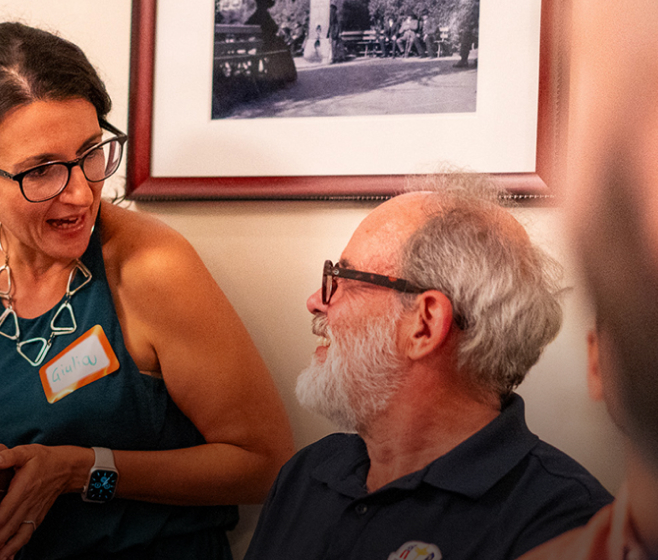





You can speak Italian with some confidence. You can understand the main ideas of complex texts on both concrete and abstract topics. You can have a conversation with native speakers with ease, fluency and spontaneity.
Program Structure
Register to a pre-avanzato sub-levels:
Pre-avanzato 1
PICK A DATE AND REGISTER
COMMUNICATIVE CONTENT
- Telling an event
- Talking about habits related to school memories
- Description of a teacher, a classmate, a course, a school
- Expressing agreement/disagreement
- Expressing regret
- Showing amazement and disbelief
- Admitting something
- Criticizing an opinion or a statement
- Talking about food
- Talking about taste
- Expressing a preference
- Description of a dish
- Describing a procedure in detail
- Reporting information
- Expressing percentages/statistics and commenting on them
- Framing a fact in a past century
- Reporting an event or a historical fact
- Expressing and discussing your point of view in informal contexts
GRAMMAR
- Use of the auxiliary verbs ESSERE or AVERE in the Passato Prossimo
- Verbs with double auxiliary in the Passato Prossimo
- Cavarsela and Entrarci
- Review of past tenses : passato prossimo, imperfetto, passato remoto
- Relative pronouns Chi, Ciò che
- Indefinite words
- Future perfect (Futuro anteriore)
- Subjunctive with indefinites
- Dislocation to the left (?) Dislocazione a sinistra
- Passive voice
- Verbs + prepositions
- Time indicators Allora, Un giorno
- Indirect speech introduced by di
- Use of conditional to express uncertain information
- Non perchè + subjunctive
- Indirect interrogative sentences
AVAILABLE CLASSES
Unfortunately we don't have available classes for this program. If you need more information, please contact us.
CONTACT US
TEXTBOOK
Book (mandatory)
Nuovo Espresso 4 Chapters 1-2-3
Pre-Avanzato 2
PICK A DATE AND REGISTER
COMMUNICATIVE CONTENT
- Talking about work
- Making a request and respond formally
- Talking clearly and politely in a formal situation
- Communicating a desire or an intention
- Exchanging complex information and advice about work
- Expression of emotions in formal and informal situations
- Talking about oneself
- Description of people
- Complaining
- Interviewing someone
- Film genres
- Expressing taste and preferences
- Telling the plot of a movie
- Review a movie
- Expressing criticism
GRAMMAR
- Use of subjunctive with relative sentences
- Use of subjunctive with relative superlative
- Difference between Finalmente and Alla fine
- Gerund with causal and hypothetical function
- Tense correlation: conditional with subjunctive
- Professions (feminine and masculine)
- Adjectives formed from nouns
- Use of the postponed possessive adjectives
- Uscirsene
- Use of possessive Proprio
- The formation of the opposite of nouns and adjectives
- Different ways to express SE in the hypothetical sentence
- Hypotheticals (irrealtà)
- Come se – Senza che + subjunctive
- Position of adjectives
- Subjuncive with the negative main clause
- Subjuntive with Purché
- Fare + infinitive
AVAILABLE CLASSES
Unfortunately we don't have available classes for this program. If you need more information, please contact us.
CONTACT US
TEXTBOOK
Book (mandatory)
Nuovo Espresso 4 Chapters 4-5-6
Pre-Avanzato 3
PICK A DATE AND REGISTER
COMMUNICATIVE CONTENT
- Visiting a museum
- Starting and ending a presentation
- Telling by specifying details
- Focusing on a specific part of the speech
- Description of an image
- Expressing agreement/disagreement
- Sustainable Italy
- Expressing an opinion and an evaluation
- Taking about environmental problems
- Making proposals
- Expressing wishes
- Curiosities about Italy
- Expressing doubts
- Explaining something
- Congratulate
- Asking and giving advice
GRAMMAR
- Prepositions In and A
- Subjunctive tenses correlation
- Infinitive used as a noun
- Relative pronouns
- Relative pronoun Il cui
- Relative pronoun Il che
- Position of pronouns with gerund, past participle, infinitive and imperative
- More about the position of the adjective
- Future (Different uses)
- Position of the adverbs
- Definite articles with geographic nouns
- Gerund present and past
- Some expressions with pronominal verbs : A dirla tutta, Sbrigarsela da soli, Arrampicarsi sugli specchi
- Homonyms
- Words with two plurals
AVAILABLE CLASSES
Dates
Day/time
Teacher
Price
October 19 to January 4 (10 WKS) *no 12/21, 12/28
M 6:00 - 8:00 pm PT
Teacher: Jimmy (ONLINE)
$390/term
October 21 to January 6 (10 WKS) *no 12/23, 12/30
W 6:30 - 8:30 pm PT
Teacher: Antonella (ONLINE)
$390/term
TEXTBOOK
Book (mandatory)
Nuovo Espresso 4 Chapters 7-8-9
Pre-Avanzato 4
PICK A DATE AND REGISTER
COMMUNICATIVE CONTENT
- Conducting an interview
- Contradicting a common opinion
- Discussing a topic
- General Review
GRAMMAR
- Subjuntive with comparative sentences
- Subjunctive with : In modo che, Far sì che
- Plural of compound words
- Use of Mica
- Some idiomatic expressions : Prendersela, Darci giù…
- Comparative of equality Tanto quanto
AVAILABLE CLASSES
Dates
Day/time
Teacher
Price
October 15 to January 7 (10 WKS) *no 11/26, 12/24, 12/31
TH 6:00 - 8:00 pm PT
Teacher: Jimmy (ONLINE)
$390/term
TEXTBOOK
Book (mandatory)
Nuovo Espresso 4 Chapter 10 + General review
PRICE
Prices are listed next to each group.
A 15$ nonrefundable processing fee will be automatically added at checkout.
Books are not included in the enrollment price.
DISCOUNTS
ENROLL IN 2 GROUPS: if you enroll in 2 groups in the same Term, you will get a 15% discount on the second group's enrollment (the less expensive)
This discount will be applied automatically upon enrollment.
Additionally, send an email to italianschool@sfiis.org to get the following discounts:
BRING A FRIEND: If you enroll with a friend (new to IIS), you both get a 10% discount on your first enrollment with IIS
PRIVATE CLASSES: if you are enrolled in a group, you can purchase private classes with a 10% discount
BULK REGISTRATION: if you enroll in 2 or more Terms at the same time, you will not pay the $15 processing fee and will get an additional 10% discount
A 15$ nonrefundable processing fee will be automatically added at checkout.
Books are not included in the enrollment price.
DISCOUNTS
ENROLL IN 2 GROUPS: if you enroll in 2 groups in the same Term, you will get a 15% discount on the second group's enrollment (the less expensive)
This discount will be applied automatically upon enrollment.
Additionally, send an email to italianschool@sfiis.org to get the following discounts:
BRING A FRIEND: If you enroll with a friend (new to IIS), you both get a 10% discount on your first enrollment with IIS
PRIVATE CLASSES: if you are enrolled in a group, you can purchase private classes with a 10% discount
BULK REGISTRATION: if you enroll in 2 or more Terms at the same time, you will not pay the $15 processing fee and will get an additional 10% discount
DURATION
Group Classes
from 5 to 10 weeks groups, different duration
Term 1
January 18 to March 28, 2027
Term 2
April 12 to June 20, 2027
Term 3
August 2 to October 3, 2027
Term 4
October 15, 2026, to January 10, 2027