


Sweet traditions: the surprising history of Panettone and Pandoro


More than just a Christmas dessert
Every December, shelves in Italy — and now across the world — fill with elegant boxes of panettone and pandoro, the golden stars of the Italian holiday table. In the U.S., they’ve become symbols of Italian dolcezza, often gifted, shared, or toasted with prosecco.
But here’s the twist: while they seem ancient and deeply traditional, panettone and pandoro are actually surprisingly modern creations.
And unlike most traditional foods, their story doesn’t start in home kitchens — it starts in factories.
Panettone: Milan’s sweet revolution
The legend says panettone was born in 15th-century Milan, when a young baker named Toni burned the duke’s Christmas dessert and improvised with leftover dough, butter, sugar, and raisins. Thus “il pan di Toni” — Toni’s bread — became panettone.
It’s a great story. But in truth, the panettone as we know it — the tall, dome-shaped, buttery loaf that graces holiday tables — didn’t appear until the early 20th century, when two Milanese companies, Motta and Vergani, began mass-producing it using industrial baking techniques.
In other words: panettone is a child of modernity — a dessert born from innovation, not folklore.
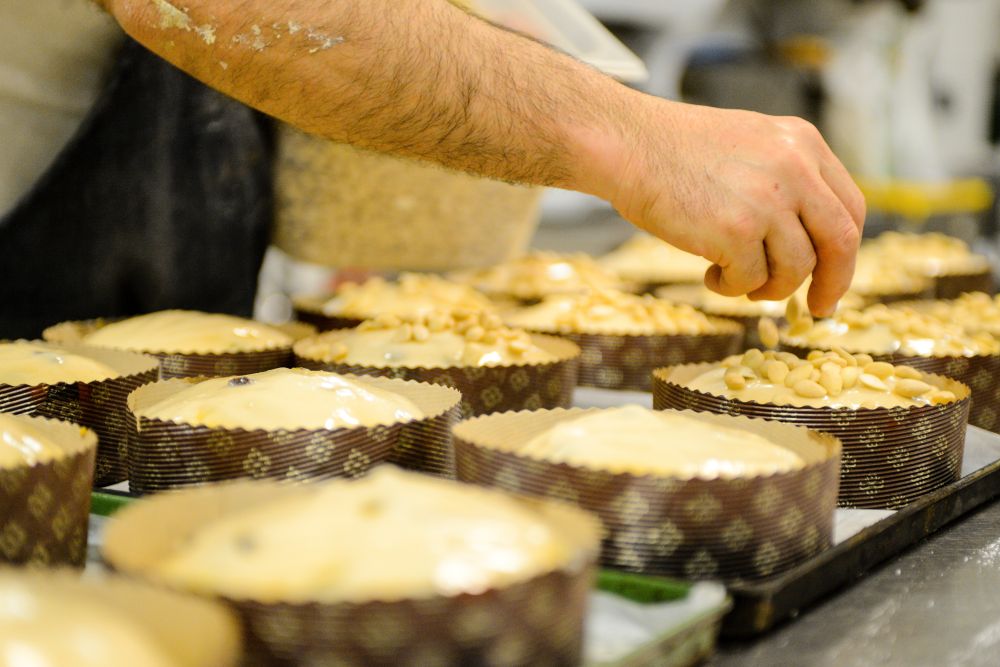
And today, in a deliciously ironic twist, we’ve come full circle: artisanal panettone has become the new luxury symbol. Small bakeries and pastry chefs across Italy (and the world) now spend days crafting “handmade” versions of what was once the pride of industrial progress.

Pandoro: Verona’s golden star
If panettone is Milanese elegance, pandoro is Veronese refinement. Its name literally means “golden bread,” a nod to its color and richness.
Though similar sweet breads existed in Austria and Venice centuries earlier, the pandoro we know today was first patented in 1894 by Domenico Melegatti — yes, the founder of the company still bearing his name.
So, like panettone, pandoro wasn’t born in someone’s grandmother’s oven — it was born in a factory, from creativity, science, and marketing genius. Its sleek, star-shaped mold and sugar-dusted top quickly became icons of modern Italian design and indulgence.
What Italians laugh at
- The Family – Jokes about mammoni (mama’s boys) or endless family dinners.
- Bureaucracy – Long lines at the post office, endless forms, absurd rules.
- Gestures and Exaggeration – Italians laugh not only at words, but at how they’re said—with raised eyebrows, dramatic pauses, and hands flying in the air.
- Self-Mockery – Italians often make fun of themselves or their own region. A Milanese might joke about being too serious; a Neapolitan about being too dramatic.

From industry to art: The paradox of “Tradition”
Usually, traditional foods start small — recipes passed down through generations, later adopted by larger producers. But panettone and pandoro took the opposite path: they began as industrial triumphs, then became symbols of authenticity.
It’s the reverse evolution of Italian food: from machine to artisan, from innovation to nostalgia.
And maybe that’s what makes them so fascinating — they remind us that “tradition” in Italy is never static. It’s constantly reinvented, reinterpreted, and re-loved.

From Milan to the Bay Area: a slice of Italy at Poesia Café
Here in the Bay Area, we’re lucky enough to enjoy truly excellent panettoni — no import required.
Our friends at Poesia Café, one of our beloved community partners, are bringing this Italian tradition to life with beautifully made artisanal panettoni, baked locally with care, creativity, and of course, a touch of poetry.
Fun fact for IIS students:
Show your IIS student ID and enjoy a special discount at Poesia Café — the perfect reason to take your Italian studies from the classroom straight to the dessert table.
Why It matters (even beyond dessert)
Like language itself, Italian cuisine evolves through people — through hands, time, and memory.
Learning Italian means learning to appreciate these nuances: how something “modern” becomes “traditional,” and how culture keeps rewriting its own story with sweetness and pride.
At Istituto Italiano Scuola, we love teaching these connections — because to truly understand Italy, you have to taste it, too.